

Marketplaces are important for expanding reach and acquiring new consumers. On the other hand, the channel itself tends to assume a more relevant role when the objective is to increase recurrence, strengthen the relationship with the customer, and have greater control over data, experience, and margin.
For companies that rely on digital sales, the discussion between marketplace and own channel it doesn’t have to be treated as a definite choice between one or the other.
In practice, the two channels can coexist within the same strategy.
While marketplaces help to bring the brand before a larger audience, their own apps, websites and platforms allow us to build a more direct relationship with those who already know and buy the company.
Therefore, the challenge lies precisely in finding this balance: using third-party platforms to gain reach and, at the same time, to develop own channels to increase loyalty, recurrence, and control over the journey.
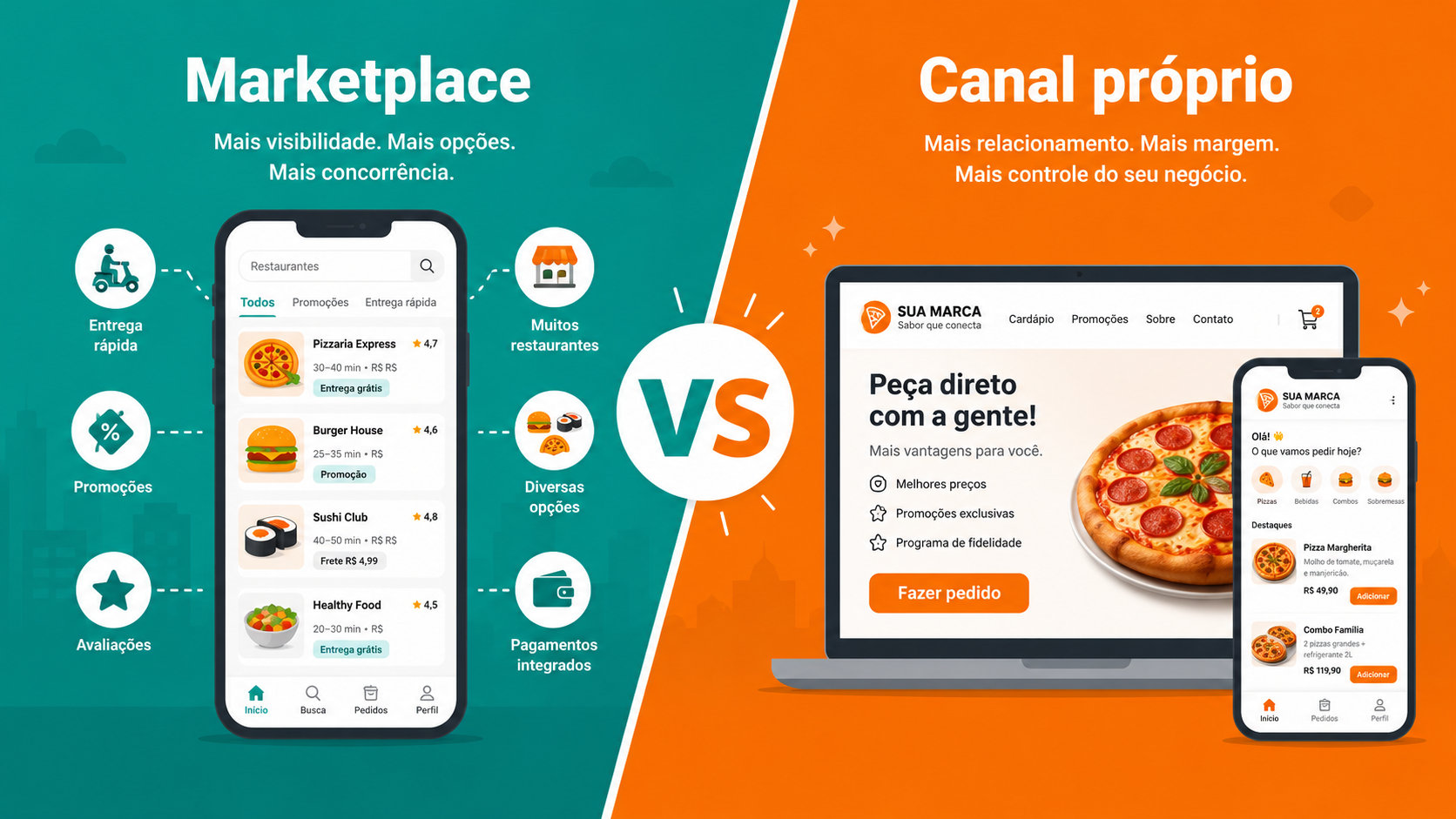
The problem: relying too much on third-party platforms
Marketplaces have simplified the entry of many companies into the digital environment.
In addition to concentrating consumers, these platforms offer ready-made infrastructure and can generate a significant volume of sales.
However, when practically all digital operations depend on these channels, the company also begins to depend on the rules, costs, and limitations imposed by the platform.
This includes commissions on sales, commercial policies, placement within the app, and limited access to consumer information.
Consequently, the company may know very little about who it is buying.
She makes the sale, but she can’t always understand in depth who that customer is, how often they buy, what products they prefer, or what could make them return.
Thus, this lack of proximity can hinder precisely one of the most important stages of the business: Turn a first purchase into a recurring one.
The cost of not building your own customer base
Conquering new consumers requires investment.
Campaigns, media, promotions, and exposure within marketplaces are part of this process.
However, the problem occurs when the company needs to invest again to reach a customer that has already purchased before.
Without its own base and without relationship mechanisms, each new sale may end up depending again on the platform that made the initial brokerage.
Over time, this can increase the acquisition cost and reduce the ability to create a lasting relationship with the consumer.
In addition, the company loses opportunities to work on important actions, such as recovering inactive customers, personalized campaigns, exclusive benefits, and communication based on purchase history.
It is precisely at this point that a Own channel is beginning to gain strategic importance.
The solution: combining acquisition and loyalty
The strategy doesn’t have to be to abandon marketplaces.
On the contrary, for many companies, the most efficient model is to use the different channels according to the role that each one plays.
The marketplace can work as a tool for Acquisition and discovery.
On the other hand, the application, website or its own platform can be used to develop relationship, loyalty and repurchase.
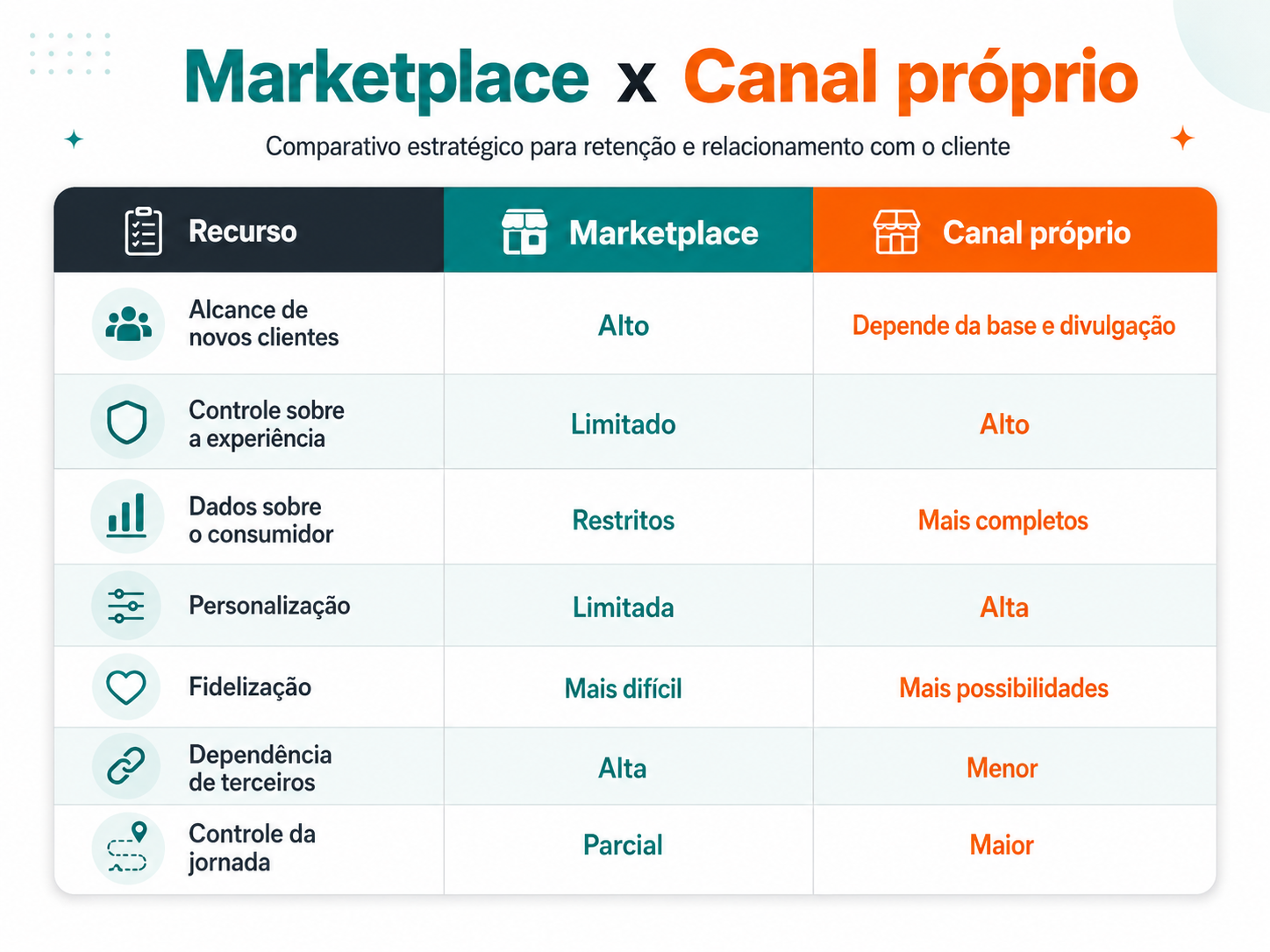
Therefore, the objective becomes to create a strategy capable of harnessing the power of marketplaces without leaving the entire relationship with the customer in the hands of third parties.
1. Create real benefits on your own channel
For a consumer to choose to buy directly with the brand, there must be a clear reason.
After all, it’s not enough to simply launch an app and wait for people to migrate to it.
The channel itself must deliver benefits.
For example, this can happen through:
- exclusive prices and conditions;
- cashback;
- points program;
- coupons;
- exclusive products or services;
- recurrence benefits;
- personalized offers;
- specific experiences for registered customers.
Thus, when there is a perceptible advantage, the channel itself begins to compete not only for price, but also for experience and relationship.
2. Facilitate the shopping experience
Another important factor is convenience.
If buying directly with the company is more difficult than using a marketplace, the consumer is unlikely to change behavior.
That’s why the experience needs to be simple.
Quick registration, easy payment, order history, repurchase, order tracking, location of units and different delivery options are some examples of features that can reduce friction during the journey.
Consequently, the easier it is to buy again, the greater the chance of recurrence.
3. Use data to personalize the relationship
One of the main benefits of having your own channel is the possibility to learn more about the behavior of the customer base.
With the appropriate integrations and authorizations, the company can analyze information such as:
- purchase history;
- frequency;
- medium ticket;
- favorite products;
- location;
- response to campaigns;
- use of coupons;
- participation in loyalty programs.
From this data, it is possible to create much more specific actions.
For example, a customer who hasn’t purchased in a few weeks may receive a reactivation campaign.
In the same way, someone who always buys a certain product may receive a related offer.
In addition, frequent customers may have access to exclusive benefits or experiences.
In this way, communication ceases to be generic and becomes part of a relationship strategy.
4. Integrate your own channel into the operation
A digital channel shouldn’t work in isolation.
To generate results, it needs to talk to other company systems.
Depending on the operation, this may involve integrations with POS, ERP, inventory, logistics, payment methods, CRM, marketing platforms, loyalty and service systems.
When this information is connected, the journey becomes more consistent for both the consumer and the operation.
In addition, the company is able to reduce manual tasks, better track orders, and make decisions based on centralized data.
In other words, the channel itself ceases to be just a sales interface and becomes part of the company’s operating structure.
5. Turn a purchase into a recurring one
Loyalty doesn’t just happen because the customer installed an app.
In fact, it happens when there is a reason to return.
Therefore, the channel itself needs to be designed to remain relevant after the first purchase.
Cashback, points, challenges, exclusive campaigns, subscriptions, personalized offers, and segmented communication are some ways to stimulate this return.
At the same time, these strategies help create a relationship that goes beyond a one-time purchase.
The objective, therefore, is to make the consumer stop seeing the app just as a place to buy and start to see it as The official brand relationship channel.
Marketplace or own channel: where to concentrate efforts?
The answer depends on the objective.
If the priority is to rapidly expand reach and appear to new consumers, marketplaces can play an important role.
On the other hand, if the objective is to increase recurrence, get to know the customer better and build a more direct relationship, the channel itself gains more relevance.
In this sense, many companies can benefit from a hybrid strategy:
marketplace to expand brand discovery and own channel to develop relationships.
So the main point is not to be on every channel.
More important than that is understanding what role each of them plays within the customer journey.
How Alphacode Can Help
At Alphacode, we developed applications, digital platforms and tailor-made systems for companies that want to structure or evolve their own channels.
In addition to user experience, projects may involve integrations with internal systems, payments, loyalty, delivery, CRM, logistics, analytics, and other technologies necessary to connect the digital environment to the operation.
Thus, the digital channel does not work as an isolated solution. It now integrates different important aspects of the transaction and of the relationship with the consumer.
Because creating your own channel doesn’t just mean developing an app.
Above all, it means building a structure that allows the company to know its customers better, create new experiences and generate more opportunities for recurrence.
FAQs
Is it necessary to abandon marketplaces to invest in your own channel?
No. Both channels can be part of the same strategy.
While marketplaces can continue to be used for acquisition and outreach, the channel itself can play a greater role in loyalty and recurrence.
How to bring customers from the marketplace to your own channel?
The official channel must offer clear advantages.
For example, cashback, coupons, loyalty programs, exclusive products, or a more convenient shopping experience can help make your own channel more attractive.
Is your own app just for selling?
No.
In addition to sales, it can concentrate loyalty, benefits, communication, payments, service, services, data, and different experiences related to the brand.
Is it worth investing in your own app?
It makes sense when there’s a clear strategy for the channel.
Therefore, the application must solve consumer needs and, at the same time, generate value for the operation. Otherwise, it risks becoming just another channel with no recurrence.
Conclusion
Marketplaces continue to be important to the digital strategy of many companies.
However, building the entire customer relationship within third-party platforms may limit data, personalization, and loyalty.
A proprietary channel, on the other hand, offers the company the opportunity to take greater control over this journey.
Therefore, rather than choosing between marketplace or app, the strategy is to use each channel correctly.
The marketplace can help the customer find your brand. The channel itself may give reasons for him to keep coming back.
Do you want to create or evolve your company’s own channel?
Alphacode develops tailor-made digital applications and platforms, connecting experience, technology, and operation.
Talk to our team and discover how to structure a digital channel capable of generating relationships, loyalty and recurrence.
Recent Comments